

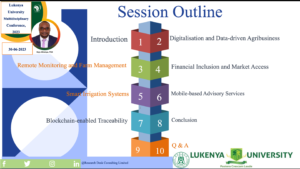
I was recently invited by the planning committee for the 4th Virtual International Multidisciplinary Conference, themed ‘Transformative Technologies, Innovations, and Management Practices for Sustainable Solutions in Food Systems and Climate Change, through a Multidisciplinary Approach” by Lukenya University, School of Agriculture and Applied Sciences, in Kenya as a Guest Speaker for the third and final day of the annual event. I titled my speech ‘Trends in Agritech in Africa: Innovations Driving Agricultural Transformation‘.
Below is the detailed speech:
Introduction
Distinguished guests, Fellow Researchers and Lecturers, esteemed delegates, and stakeholders of the 4th Virtual International Multidisciplinary Conference, hosted by Lukenya University, School of Agriculture, Technical Studies and Natural Sciences, I am honoured to stand before you today to discuss the crucial topic of “Trends in Agritech in Africa: Innovations Driving Agricultural Transformation.” As we gather here on this date, 2023-06-30, we are witnessing a momentous period in Africa’s agricultural journey, driven by disruptive technologies, digital innovations, and a collective commitment to harness the potential of agritech for sustainable growth and development.
Story
Once upon a time in a small farming village called Greenfield, the community faced numerous challenges in their agricultural practices. Farmers struggled with unpredictable weather patterns, inefficient irrigation systems, and limited access to market information. As a result, crop yields were inconsistent, and farmers often struggled to earn fair prices for their produce.
However, the winds of change blew into Greenfield when a group of tech-savvy entrepreneurs introduced the concept of agritech and digital agriculture to the village. They set up a local cooperative called AgriConnect, aiming to empower farmers with digital tools and technologies to transform their farming practices.
The farmers eagerly embraced this opportunity and began incorporating various digital solutions into their daily routines. They used sensors and connected devices to monitor soil moisture levels, temperature, and humidity, allowing them to make informed decisions about irrigation and pest control. Drones equipped with advanced imaging systems helped identify crop diseases and nutrient deficiencies at an early stage, enabling farmers to take prompt action and minimise losses.
AgriConnect also introduced a digital platform that provided real-time market information, allowing farmers to make better decisions about when, where, and at what price to sell their produce. This platform enabled direct communication and transactions between farmers and buyers, eliminating middlemen and ensuring fair prices for both parties.
Over time, the impact of agritech and digital agriculture became evident in Greenfield. Crop yields increased significantly as farmers optimised their farming practices using data-driven insights. The use of precision agriculture techniques led to more efficient resource utilisation, reducing water and fertiliser wastage. The village became known for its high-quality, sustainably produced crops, attracting buyers from far and wide.
Moreover, the digital platform created by AgriConnect transformed the local economy. Farmers had better control over their market transactions, resulting in increased incomes and improved livelihoods. The village saw a rise in entrepreneurship, as tech-savvy individuals developed innovative applications and services to support the agricultural ecosystem.
The success of Greenfield’s agritech revolution caught the attention of neighbouring villages and even reached the national level. Government agencies and development organisations recognised the potential of digital agriculture and started investing in similar initiatives across the country. Training programs and financial support were provided to help farmers adopt new technologies and integrate them into their farming practices.
As the years went by, agritech and digital agriculture became integral parts of the country’s agricultural landscape. Farmers across the nation embraced these technologies, leading to increased productivity, enhanced sustainability, and improved food security. The transformation of Greenfield served as a shining example of how the digital revolution could revolutionize the entire agri-food system.
In conclusion, the story of Greenfield illustrates the importance of agritech and digital agriculture in revolutionising traditional farming practices. Through the use of digital technologies, farmers can optimise their farming processes, improve resource efficiency, access market information, and achieve fair prices for their produce. The widespread adoption of these technologies has the potential to transform the global agriculture sector, ensuring a more efficient, sustainable, and equitable food system.
The Potential of Agritech in Africa
Africa’s agricultural sector has always been the backbone of its economy, sustaining 70 percent of livelihoods. However, agricultural productivity has faced challenges, leading to food insecurity for millions. Today, we embark on a journey to explore the transformative potential of agritech in reshaping Africa’s agricultural landscape. Africa’s agritech sub-sector is experiencing exponential growth and is projected to have a value of USD 1 trillion by 2030. Agritech solutions are playing a crucial role in optimising yields, improving sustainability, and boosting farm productivity.
The Agritech Revolution: Harnessing Disruptive Technologies
The rapid development of disruptive technologies has revolutionised agricultural value chains in Africa. Emerging innovations such as Artificial Intelligence (AI), Internet of Things (IoT), edge computing, and precision farming have gained momentum in driving efficiency and sustainability.
AI-driven technologies empower farmers and agribusiness with data-driven insights, enabling precise decision-making on crop health, weather forecasts, and soil fertility. IoT and edge computing facilitate the integration of smart devices to optimise resource use and automate critical agricultural processes and practices, thereby enhancing productivity and profitability.
Digital Solutions for Inclusive Growth
Digital solutions are a catalyst for inclusive growth in Africa’s agritech landscape. Microsoft’s 4Afrika initiative, leveraging partnerships and extensive networks, is committed to equipping farming communities with cutting-edge technologies like AI and IoT. These initiatives help smallholder farmers optimise yields and access markets, leading to a more resilient and prosperous agricultural ecosystem.
The Role of Startups and Private Sector
Agritech startups, led by the private sector, have played a crucial role in driving innovation and addressing challenges in agriculture. These startups have attracted significant investments, fuelling the development of advanced technologies tailored to Africa’s unique agricultural context.
Africa’s Journey Towards Agricultural Transformation
Africa’s agricultural transformation journey has witnessed significant milestones. The New Partnership for Africa’s Development (NEPAD) and the Comprehensive Africa Agriculture Development Programme (CAADP) have been instrumental in driving agricultural development. However, more efforts are needed to accelerate progress and achieve the zero-hunger target.
Challenges and Opportunities
While Africa holds tremendous potential in agriculture, challenges persist. Climate change, limited access to finance, and traditional farming practices impede growth. Nonetheless, these challenges present opportunities for technological interventions, regenerative agriculture practices, and greater collaboration between public and private stakeholders.
Empowering Farmers with Knowledge and Skills
Agritech is not just about technology; it is about empowering farmers with knowledge and skills to utilise these tools effectively. Access to training, capacity building, and awareness programmes are essential to ensure that farmers embrace and benefit from agritech innovations.
Concluding remarks
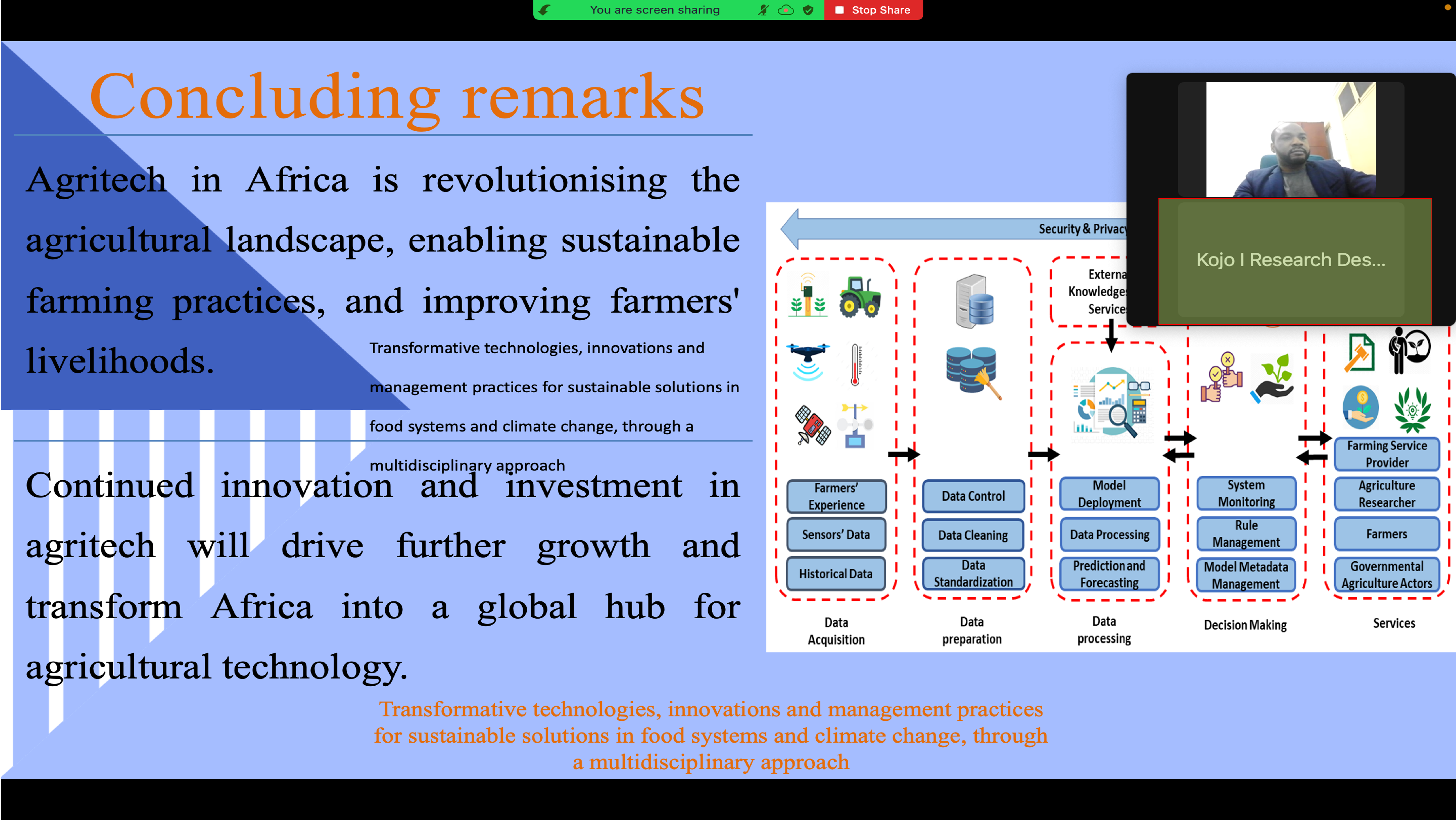
As we move forward, we must recognise that the journey towards agricultural transformation through agritech is not solely about technology; it is about the people. Africa’s farmers and agribusiness are at the heart of this transformation, and it is our collective responsibility to support and empower them. Together, we can harness the power of disruptive technologies and digital innovations to drive sustainable, inclusive, and resilient agricultural growth in Africa.
Let us seize this moment, embrace the opportunities, and work hand in hand to usher in a new era of farming and agribusiness in Africa, where innovation and technology lead the way toward a prosperous and food-secure future.
Thank you
Research Desk Consulting Limited