
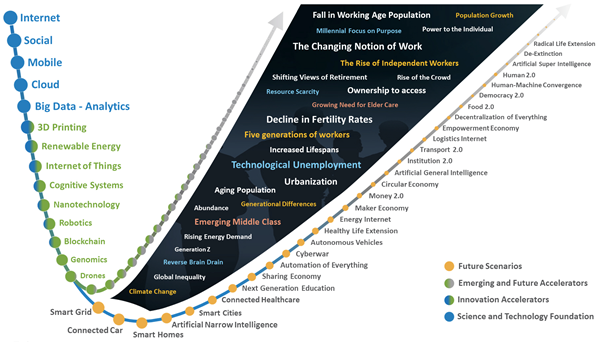

Overview of Fourth Industrial Revolution Innovations
New, emerging, and disruptive technologies including Artificial Intelligence (AI), Blockchain, Internet of Things (IoT), Big Data, Geographical Information System (GIS), Machine Learning and Neural Networks (MLNN), Remote Sensing, Biosensors, and unmanned aerial vehicles (drones) are all part of the Fourth Industrial Revolution (4IR) innovations (https://www.weforum.org/agenda/2016/01/the-fourth-industrial-revolution-what-it-means-and-how-to-respond/). Using digital transformation and automation, 4IR innovations offer novel methods for organising, producing, and distributing physical goods, erasing boundaries and transforming them into a comprehensive, complex system of interrelated and interdependent components. Consequently, these technologies have the potential to improve agricultural productivity and profitability, as well as the promotion of local value addition of agribusiness commodity value chains in Africa.
The application of the 4IR innovations in agriculture however takes a gen Z jargonised terms such as agtech, agritech, AgriTech or agrotech; which is the use of 4IR innovations in the fields of agriculture, agribusiness, horticulture, and aquaculture with the goal of increasing yields, productivity, and profitability. The future of agriculture will be built on the integration of a range of disciplines, including genomics and genetics; soil nutrition; crop science; meteorology; hydrology; software engineering; hardware design and manufacture; agribusiness and innovation in business models; financial services; logistics; and market research and marketing. The essential parts of agriculture, including biological and biophysical, mechanical, environmental, and human, must be integrated for digital agriculture/agtech to be effective. Thus, precision agriculture, enabled by IoT, Big Data, and AI technologies, will increase agricultural production and profitability by transforming farming and activities in commodity value chains. Data collected by IoT devices can be used by farmers to better manage their operations. For example, IoT-enabled sensors in the field can collect data on soil moisture and nutrients to increase irrigation efficiency, develop soil profiles-specific fertiliser blends, and decide the best time to sow or harvest. By automating temperature, humidity, light intensity, and watering, IoT sensors can reduce or eliminate the need for manual monitoring in greenhouses altogether. Monitoring livestock’s health, reproduction, and their whereabouts can also be done via IoT technologies (Figure 1).

Figure 1. Technologies fueling 4IR innovations. Source: Word Economic Forum
Historical perspectives of Agtech
The development of new technologies has had significant impact on agricultural development. Agricultural innovations have occasioned substantial shifts in farming practices and output. There has been a strong correlation between productivity and advances in agritech. The earliest known evidence of irrigation technology dates to the 6th millennium BC in Khuzestan in the south-west of present-day Iran, where it was developed separately by several different cultures.
The introduction of agricultural machinery to mechanise agricultural labour during the Industrial Revolution marked a watershed moment in agricultural technology. Manual labour and working animals like oxen, horses, and mules have been supplanted by contemporary mechanised agriculture powered by technology. In the 19th century, weather forecasting was developed and barbed wire was invented. Portable engines and threshing machines became more widely used when improvements were made. Synthetic fertilisers and pesticides, mass-produced tractors, and agricultural planes for aerial application of pesticides were all developed in the 20th century, along with new agricultural machinery. Soilless farming techniques such as hydroponics, aquaponics, and aeroponics were used to grow vegetables including lettuce, radishes, and cucumbers (Figure 2).
A number of agtech(s) have been developed and adopted since the early 2000s. Farmers are increasingly relying on agricultural robotics, drones and driverless tractors, while digital agriculture and precision farming utilise considerable data collection and processing to increase farm productivity. Precision beekeeping, precision livestock husbandry, and precision viticulture are all examples of precision agriculture.

Figure 2. Industrial revolutions fueling evolution of innovations. Source: Deloitte
Investing in low-cost digital agriculture technologies could increase productivity, allowing for upskilling rather than downtraining, higher output and better quality at lower costs, better use of land as an asset, and improved sustainability of the agrifood industry as a whole. There will be more and more disruptions as digital technology advances from novelty to prevalence across social media. However, agriculture is still lagging behind more technologically advanced sectors like biotechnology, aeronautics, mining, and advanced manufacturing in experiencing the full influence of 4IR innovations. In agriculture, 4IR innovation should be about connectivity, and it should be possible to forecast results, or at least increase the level of certainty that an event will occur. 4IR innovations are designed to free up time, energy, and space so that users may think more creatively (Figure 3).

Figure 3. Technologies fueling 4IR innovations. Source: Deloitte
Digitising agronomic practices, information and data in agriculture
Modern agriculture is a major contributor to environmental degradation, accounting for the degradation of terrestrial and aquatic ecosystems, reducing water availability, and accelerating climate change. Agriculture accounts for about 26 percent of anthropogenic greenhouse gas emissions, 32 percent of the terrestrial acidification, 78 percent of eutrophication, and two-thirds of freshwater depletion globally. Digitisation of agricultural processes/activities and data, a key route for data capture is a central feature of rapidly advancing agricultural innovations. As a fundamental element of big data, streaming data is essential to creating the evidence foundation for effective decision making. This is applicable from product to producer and supply chain, regional, national and international development, policy and governance decisions, as well as investment, and diversification decisions. The use of 4IR innovation (technology) is only a means to an end. If all else fails, the goal may be decision-making, but it could also be a better understanding of the marketplace and the ability to respond quickly and effectively to changes in market dynamics (Figure 4).
Farmerline (https://farmerline.co/) and Agrocenta (https://agrocenta.com/), both Ghanaian agritech companies, provide farmers with mobile and web-based technologies for agricultural advisory, weather information, market and financial services. Esoko (https://esoko.com/) provides farmers and other players in the agriculture space with strong data collection and digitisation technologies, biometric profiling, analytics, communication services, digital credit, insurance, payments, and transaction services.

Figure 4. Smart Farm, an agritech solution for open agriculture. Source: Shutterstock
Artificial intelligence and machine learning in Agriculture
Artificial intelligence (AI) and machine learning (ML) rely heavily on digital technologies. For example, AI and ML can be applied in agronomy, crop science, climate modeling, agri-finance, genetics and robotics. Precision farming hinges heavily on AI, both with and without the use of robotics. Automation has the potential to increase productivity and alleviate workforce shortages. Artificial intelligence improves predictive agriculture, which is a primary source of constraint at the moment. Internet of Things (IoT) applications in agriculture include fully automated production, administration, systems management, transportation and logistics and even market selection as well as market access for agri-produce (Figure 5). This is a glimpse into a future that is closer than many people expect, despite the fact that this is an extremely rare circumstance. Individuals, businesses, institutions and governments are all working hard to find a solution to problems of food security. The rapid integration of what may appear to be different solutions will be facilitated by enabling technological platforms. In essence, AI and ML coordinate cyber-physical systems in agriculture and agribusiness. With the IoT, big data, and blockchain technology, Complete Farmer (https://www.completefarmer.com/), a Ghanaian agritech startup offers cutting-edge technological farming protocols and innovations, as well as a distinctive business model and logistics that are revolutionising farming and creating an end-to-end digital marketplace that enables consumers to source agricultural commodities grown to their specifications in Ghana.

Figure 5. A drone spraying a vegetable field in Ghana. Source: Aqua Meyer Drones
Big Data application in agriculture
Big Data and AI can assist farmers to access complex information that can be used to inform farming decisions. Farm management decision-making is aided by AI, which boosts the value of acquired data by evaluating and translating it into information to support farm management decisions. It can be employed at a variety of scales, from decoding data obtained on individual animals and plants to the entire farm by extracting germane information for crop planning and monitoring. Agriculture can benefit from big data and AI by improving focused allocation of inputs such as fertiliser and chemical application (Figure 6). CowTribe (https://www.cowtribe.com/), another Ghanaian agritech startup built a smart logistics platform to aggregate last-mile farmer demand for livestock/veterinary products and then deliver them to their farms in Ghana.

Figure 6. Key sectors witnessing applications of 4IR innovations. Source: Shutterstock
Genetics and genomics are at the heart of agtech
Farmers are able to boost yields and reduce the use of pesticides, fungicides, herbicides, insecticides, and nematicides thanks to genomics in agriculture. Breeding new plant and animal types has enormous benefits for farmers aiming for high-value markets both domestically and internationally (Figure 7). Recent gene editing tools such as CRISPR and Prime editing have advanced the development of novel and climate-smart genotypes and breeds for the global community.

Figure 7. Plantlet growing simulated in a tissue culture lab. Source: unknown
Biosensors and blockchain application in Agriculture
Productivity will be boosted by remote management and the ability to work in different locations. An example of how farmers can save time and money is by installing sensors in their wells that allow them to monitor their livestock’s watering needs from afar and save them four hours of driving each day. Pre- and post-harvest measurement and performance monitoring using mesh networks, along with market and consumer data can be fully implemented to ensure that vegetables sold on the spot market are in peak condition and fetch premium price. To improve supply chain coordination and transparency, new digital technologies like blockchain and distributed ledger are being hailed as key facilitators for provenance tracking and value addition. As a result, major participants in value chains are also using blockchain technology to maintain and enhance their bargaining leverage (Figure 8).
A study on developing agribusiness financial models supported by quick acceptance of accounting systems such as mfarmpay (https://mfarmpay.io/), a Kenyan/Ghanaian-based agritech startup, rolled out a scalable loan origination and credit app driving financing to millions of financially underserved rural African smallholder farmers in multiple markets; and Farmwallet (https://farmwallet.io/), a Ghanaian agritech startup uses mobile phones, data, blockchain and machine learning to close the critical data gap that prevents financial institutions from lending to creditworthy smallholder farmers in Northern Ghana. All these solutions were aimed at strengthening the evidence foundation for better decision making at the farm level. To attain market dominance, however, agritech companies can leverage the market size by the competitive knowledge they share. Sesi Technologies (https://sesitechnologies.com/) manufactures GrainMate Grain Moisture Meter to reduce post harvest losses in grain production. GrainMate Grain Moisture Meter is fixed with moisture sensors and linked to mobile app for smallholder grain farmers and commercial agribusinesses/farms. Blockchain technology can assist farmers and agri-traders in increasing their earnings by improving inventory management and streamlining their food value chain, resulting in increased income for grain farmers. A blockchain is cryptographically safe by design, and it can aid in the security of contracts and transactions, particularly in the areas of land registration and crop insurance.

Figure 8. A nondestructive soil tester powered by a biosensor. Source: unknown
Unmanned aerial vehicle use case in Agriculture
Drones are unmanned aircrafts that are used mostly for yield optimisation, crop spraying and production monitoring. Drones can provide real-time information about crop growth stages, crop health, and soil variances, which can aid in any necessary mitigations. The visible and near-infrared portions of the electromagnetic spectrum can both be captured by multispectral sensors mounted on agdrones (Figure 9). ‘Agdrones’ have a significant amount of room to expand their reach in Ghana’s agricultural space. Agdrones can help farmers to assess their crops and make decisions for remedial actions based on the accurate crop information that drones collect from them. It is anticipated that the market for agricultural production digitisation and digitalisation will continue to develop.

Figure 9. AgDrone monitoring a field. Source: Built in Africa
Farmers can use a drone to screen, scout and scan their fields and properly detect problems in specific areas. This enables farmers to devote more time to the overall task of production rather than spending time surveying their crops, allowing them to maximise their profits. Some of the other applications include tracking animals, assessing fences, and monitoring pest and disease infections. Modern drones are prohibitively expensive for smallholder farmers in developing countries, due to the high costs of purchase and maintenance. These costs are being reduced by pilot initiatives in Tanzania that are manufacturing basic and sturdy agricultural drones for use. In Ghana, GEM Industrial Solutions (https://www.gemindustrialsolutions.com/) is a commercial unmanned aerial systems (UAS) service provider who provides drones for aerial mapping, inspection, surveying, and crop health, surveillance, crop dusting and spraying.
Precision spraying, crop scouting, crop vigour estimations, field inspections, high-resolution mapping and surveying, crop damage assessment and insurance claim forensics are all possible uses for drone technology in agriculture. Drone-carried equipment can distinguish which plants reflect various quantities of green light and near-infrared light by scanning a crop with both visible and near-infrared light. Using this data, multispectral photographs of plants may be created, which can be used to follow changes and assess their overall health. As a result, farmers are better able to keep an eye out for pests and diseases on their farms and document damage to their crops for insurance claims. There are many ways in which drones can be utilised to boost profitability in the livestock value chain, such as monitoring cattle remotely. AquaMeyer (https://amdronetech.com/), a Ghanaian-owned dronetech provides precision spraying, crop scouting, crop vigour estimations, field inspections, high-resolution mapping and surveying with their AquaMeyer branded drones in Ghana.
Geographical Information System and remote sensing
A geographic information system (GIS) is a computer-based tool for mapping and evaluating the features and events that occur on the planet. Remote sensing is the science of gathering data about an object or a phenomenon without coming into physical contact with the object or the event (Figure 10). In Ghana, an agritech startup, Africa Farmnet Limited (https://africafarmnet.com/) with its web and mobile-based application, MyAgro360 (https://myagro360.com/) provides an integrated AI/GIS-powered digital farm management and traceability application which can also be used for pest and disease identification, e-extension, last mile stakeholder management, location-based weather forecasting and agri-commerce platform for farmers in Ghana. MyAgro360 is an enhanced redesign of the earlier innovation, Igeza which won a second runner up Frontier Innovation award in the USAID FAWTech Challenge in 2018, Cape Town, South Africa.

Figure 10. Application of IoTs/GIS in Agriculture. Sources: CTA
Accessing new markets using IoT
In the end, technology is all about people, and therefore digital agriculture should be an innovation to interact more effectively with them. As a result, producers may have a better understanding of how their supply chain partners work or who in a particular African city is purchasing their product and why. In the field of AI, “deep learning” is a common word. It is possible to use deep learning techniques to find untapped markets and meganiches in the same way that animal and agricultural research can benefit from integrating the omics (Figure 11). By providing platforms that make tractor services available, accessible and affordable for increasing productivity and efficiency while reducing post-harvest loss, TroTro Tractor (https://www.trotrotractor.com/), a Ghanaian agritech startup employs IoT technology to democratise access to tractor services to smallholder farmers in Ghana.

Figure 11. A driverless tractor fitted with harvesters. Source: John Deere
Adoption of agritech innovation and concluding remarks
In some areas of technology adoption, such as genetics and genomics, agriculture is a leader; nevertheless, it lags behind in others, such as automated production, financial instruments, and market access. Implementing and adapting new technology can take a long period, especially in the early stages. In most cases, the story is not only about the technology; it is also about the people involved. Investment and adoption decisions are based on risk, and this is one of the most difficult obstacles for farmers, who are frequently endowed with assets but lack the financial means to invest and adopt new technologies. Technology adoption is sometimes driven by user-friendliness and functionality. There has been and continues to be a problem with digital connectivity in remote Africa. It seems unlikely that digital agriculture will be widely adopted unless this hurdle is removed.

Figure 12. Plantlet growing simulated in a tissue culture lab. Source: BizIntellia
Higher productivity on farms, as well as new agribusiness models that harness digital technologies like AI and ML will lead to higher returns and, as a result, more investment in agriculture. In contrast, agritech solutions have led to a decrease in the number of jobs on farms and the ability to provide numerous services remotely. Thus, socio-economic consequences of agritech applications could be detrimental in many regions. Nonetheless, digital technology has the potential to increase productivity, profitability, balance sheets, investment, and diversification, all of which could have a positive impact on regional economies.
For both environmental and economic reasons, it will be beneficial for agribusinesses to be able to better counteract climate change impacts. Long-term strategic decisions about regional and product diversification can be based on a solid evidence provided by predictability. It will help farmers plan for more frequent and severe weather occurrences to maintain a steady growth trajectory for their own farms and areas. There will be a variety of responses from farmers, institutions, governments, value chain partners, and consumers to the influence of 4IR innovations.
Literature Cited
AfDB (2019). Unlocking the potential of the fourth industrial revolution in Africa. Study
report.
Ehui S (2018). Why technology will disrupt and transform Africa’s agriculture sector in a
good way. Top Priorities for the Continent in 2018. Foresight Africa, 96-8. Washington, D.C.: Brookings Institution
FAO (2017). The State of Food and Agriculture: Leveraging Food Items for Inclusive Rural
Transformation, Food and Agriculture Organisation of the United Nations, Rome.
Signé L (2020). Africa’s Role in the Fourth Industrial Revolution: Riding the World’s Biggest
Wave of Disruptive Innovation. Forthcoming. See the summary online: landrysigne.com.
Ndung’u N (2021). Next steps for the digital revolution in Africa: Inclusive growth and job
creation lessons from Kenya. Brookings Institution Working Paper 20.
GSM Association (2019). The Mobile Economy: Sub-Saharan Africa 2019. GSM Association
London.
Chan R (2018). Rethinking African growth and service delivery: Technology as a catalyst. Top
priorities for the continent in 2018. Foresight Africa. Brookings Institution, Washington, D.C. 88-9.
Nsengimana JP (2018). How Africa wins the 4th Industrial Revolution. Forbes.
By Kojo Ahiakpa
Team Lead and Agribusiness Advisor
Research Desk Consulting Limited
Email: kojo.ahiakpa@researchdesk.consulting
WhatsApp: +233 277 786 645